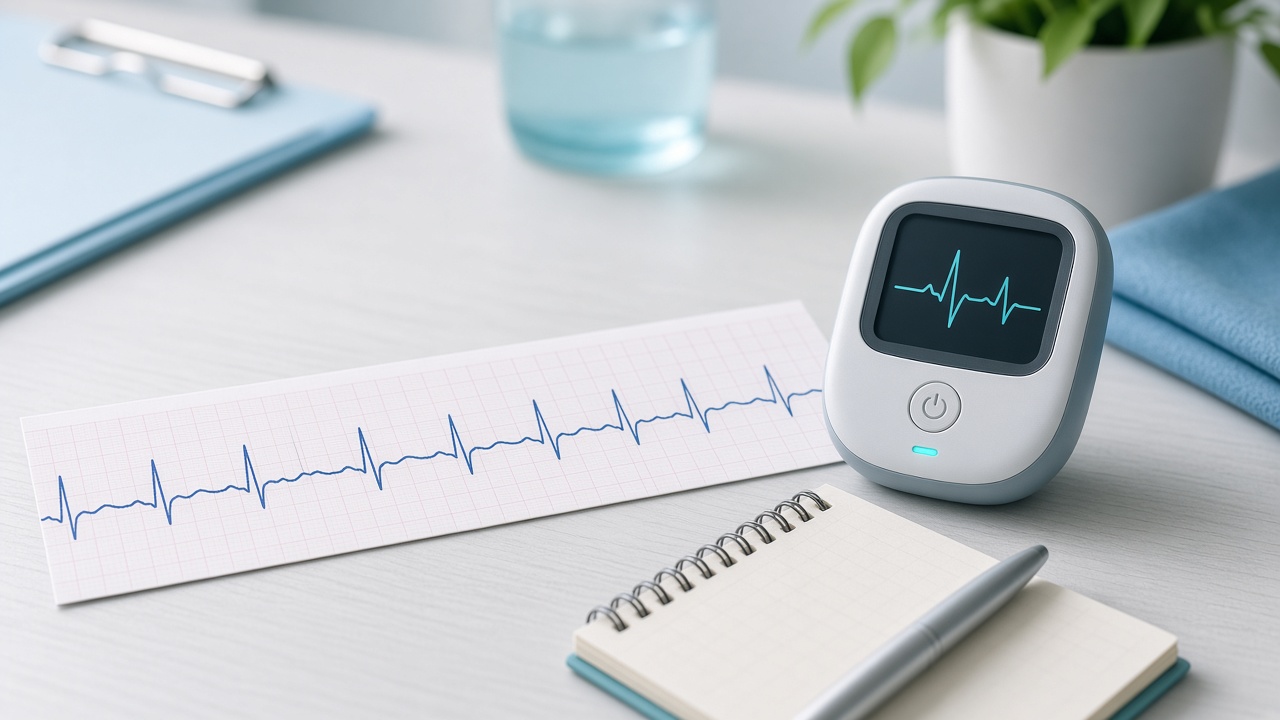

A fluttering in middle of chest is a location question, not a diagnosis. People feel a flip, a quiver, or a short run of fast beats behind the breastbone and want to know whether “middle” means something different from a flutter on the left or the right. Location alone does not answer that. It tells you where you noticed the feeling. A cardiology visit is what sorts out whether the rhythm was ordinary, extra beats, or something that needs monitoring.
The American Heart Association describes palpitations as a symptom, an awareness of the heartbeat, not a diagnosis by themselves. That is the frame for this page. If you want the broader explainer of what fluttering can mean, start with what causes fluttering in your chest. This article stays on the center of the chest. It does not replace that page, and it does not replace the left-side or right-side posts.
What people mean by the middle of the chest
Most people point to the sternum, the flat bone in the center, when they say the flutter is in the middle. Some feel it higher, near the throat. Some feel it only when they are still, lying down, or just after they sit. A few notice it while they are walking and then cannot find it again once they stop to check their pulse.
The heart sits slightly left of center, but you can feel a sensation in the middle even when the source is the heart, the esophagus, a muscle, or a burst of adrenaline. Pointing at the sternum is useful information for the visit. It is not a test.
A flutter versus a pain
A flutter is a rhythm sensation. Pain, pressure, or a heavy ache in the same spot is a different symptom, even if both show up in the center. If the center of the chest hurts, or the flutter arrives with pain, that is not a “wait and describe it later” situation. Pain with breathlessness, sweating, nausea, or fainting needs emergency care. This page will not teach you to decide that on your own.
Why the spot does not clear the heart
It is tempting to treat the middle as a safe zone and the left side as the heart zone. That shortcut is wrong. Extra beats, a short run of a fast rhythm, and a pounding pulse can all be felt in the center. So can a feeling that is not a heart rhythm at all. The fluttering that is not heart related article covers that second group. Read it if you are trying to tell a muscle twitch or a gut sensation from a heartbeat. Do not use it to clear yourself.
A clinician may still want an ECG, a longer monitor, or blood work even when you are sure the feeling sat in the middle and went away. The decision depends on how often it happens, what came with it, and your history. This article does not set a cutoff such as “under 20 seconds is fine.”
How this differs from left-side and right-side flutter
Prime already has location pages for the sides. Use them for those searches. Do not treat this page as a second left-side or right-side article.
- Fluttering on the left side of the chest is the left-side page.
- Fluttering on the right side of the chest is the right-side page.
- This page is only the center: behind the breastbone, or the spot you would point to if someone said “middle.”
- The causes page stays the hub for “what does fluttering mean” in general.
If your feeling moves, say that. A flutter that starts in the center and then seems to sit on the left is still one story. Write down where it started and where you noticed it last. The visit can use that. Three separate blog posts should not turn one symptom into three diagnoses.
Flutter and palpitations are not always the same sentence
People use both words for the same afternoon. A flutter often means a fine, rapid, or quivering feeling. A palpitation can mean a pound, a skip, or a flip. Heart flutter versus palpitations walks through that language. Bring your own words to the visit anyway. “It felt like a bird in the center of my chest for a few seconds after I lay down” is more useful than picking the medical label first.
A skipped beat versus a run of beats
One early beat can feel like a pause and then a thump in the middle of the chest. A run of fast beats can feel like a vibration that does not let you find a single pulse. You do not have to name which one it was. If you can, note whether it was one thump or a stretch of quivering, and roughly how long you noticed it. Guessing the seconds is fine. A precise stopwatch reading is not required.
Context is not a diagnosis
Caffeine, a short night, dehydration, a hot room, or a hard week can sit next to a flutter. They are context. They are not proof the feeling was harmless, and they are not proof it was dangerous. Mention them. Do not decide the visit is unnecessary because you had a second coffee.
The same goes for stress. A stressful morning can raise your awareness of a normal heartbeat until the center of the chest feels busy. It can also show up at the same time as a rhythm that deserves a look. The visit is how those get separated. A blog post cannot listen to the heart.
What to write down before you call
- Where you felt it: center, and whether it also sat left, right, or in the throat
- One thump, or a stretch of fluttering
- What you were doing: sitting, lying down, walking, after a meal, after caffeine
- What came with it: chest pain, shortness of breath, dizziness, sweating, or nothing else
- How many times it has happened, even if the number is “a few this month”
When a middle-chest flutter cannot wait
Call emergency services if the flutter comes with chest pain or pressure, fainting, severe shortness of breath, or a sense that you might pass out. New weakness, trouble speaking, or chest pain that spreads to the arm, jaw, or back is the same kind of emergency. Do not drive yourself if you are faint or struggling to breathe.
A single brief flutter with no other symptom is a reason to get it checked, not a reason to open an emergency article and stop there. If it keeps returning, if it happens while you are active, or if you already have a heart history, book a cardiology visit rather than collecting more nights of “it went away.”
- Pain, pressure, or a heavy feeling with the flutter
- Fainting or nearly fainting
- Severe shortness of breath
- A flutter during exercise that does not settle when you stop
What a visit can check
A palpitation visit usually starts with the story and an exam. An ECG is common. It catches the rhythm in that moment, which may be quiet if the flutter is not happening in the room. A longer monitor is how a clinician sees the rhythm on a day the feeling returns. Blood work sometimes looks for thyroid, anemia, or electrolytes. None of that list is a promise for your visit. The clinician chooses.
If chest pain is the louder symptom, the chest pain specialist page is the right service description. If the feeling is the rhythm itself, the palpitation specialist page is the better match. You can say both in the same appointment. You do not need to pick a perfect department name before you book.
Monitoring, and who decides
Wearable watches and home pulse checks can support the story. They do not replace a medical monitor, and a normal reading on a watch during a quiet hour does not erase a flutter from last night. Bring the reading if you have one. Let the clinician decide whether a patch, a Holter, or no monitor is the next step. This page will not tell you how many days to wear a device.
What this page will not decide
It will not say a center-chest flutter is usually harmless. Many brief palpitations turn out to be benign extra beats. Some are not. The word “usually” is how people talk themselves out of a visit they actually need.
It will not give you a cause list to self-assign. Thyroid disease, anemia, dehydration, caffeine, and rhythm problems can all sit near this symptom. Knowing the list is not the same as knowing your cause.
It will not send you to a different city page for a different diagnosis. Dallas and Rockwall have their own “when to see a cardiologist” posts. Those are booking paths. They are not flutter explanations. If you are deciding where to be seen, cardiologist in Dallas and cardiologist in Rockwall are the city pages. The symptom story stays here.
Plano, Frisco, and Allen
A lot of people who search this symptom live or work in Plano, Frisco, or Allen. The feeling does not change by city. What changes is where you book. Prime does not need you to invent a local office in the search bar. Use the schedule page or the rhythm visit, and name the symptom in the middle of the chest when you book so the visit starts on the right story.
If you already have a cardiologist and this is a new feeling, call that office and describe the center-chest flutter plus any pain, dizziness, or breathlessness. If you do not, a first visit is reasonable. You do not need a perfect diary. You need the short list above.
If you are comparing it with anxiety
Anxiety can make a normal heartbeat feel huge, including in the center of the chest. Anxiety can also show up beside a rhythm problem. A calm hour later does not prove the earlier flutter was anxiety. If you cannot tell, that uncertainty is a reason to be seen, not a reason to wait for a cleaner theory.
How to use the other flutter pages
Read one related page, not five in a row, before the visit. If your question is “what is fluttering,” use the causes page. If your question is “it is only on the left” or “only on the right,” use that side’s page. If your question is “it feels like the middle,” stay here. If your question is “maybe this is not the heart,” use the not-heart-related page and still mention the feeling at the visit.
- Center of the chest: this page
- Meaning of fluttering in general: the causes page
- Left or right only: the matching side page
- Words you are using: flutter versus palpitations
Do not stitch those pages into a self-diagnosis. They exist so the search matches the question. The exam still has to happen in the room.
Book the rhythm visit
If fluttering in the middle of the chest has happened more than once, came with dizziness or shortness of breath, or simply will not leave your mind, book a heart-rhythm visit. Say where you felt it, whether it was one thump or a quiver, and what else came with it. Leave the monitoring decision to the clinician.
Chest pain in the same spot is a different urgency. Do not finish this article first if you are in pain, faint, or cannot catch your breath. Emergency care comes before a blog post and before a routine appointment.
Schedule an appointment with Prime Heart and Vascular if a flutter in the center of your chest keeps coming back, or it showed up with dizziness or shortness of breath.
Frequently asked questions about fluttering in the middle of the chest
No. The middle of the chest is where many people notice a skip, a thump, or a short quiver. The heart sits slightly left of center, and you can still feel it behind the breastbone. A muscle, reflux, or a surge of adrenaline can land in that same spot. Location is a clue you should tell the clinician. It is not a result that clears the heart or proves the heart is the cause. If the feeling keeps coming back, book a rhythm visit and describe the spot in your own words. If it comes with chest pain, fainting, or severe shortness of breath, use emergency care instead of finishing an article.
It is a different place to point, not a different diagnosis. The left-side page is for a feeling that stays on the left. The right-side page is for the right. This page is for the center, behind the breastbone. If the feeling moves, say where it started and where you noticed it last. Do not turn one afternoon into three separate problems because three pages exist. The causes page still explains fluttering in general. Use that page when the question is what fluttering means, and use this page when the question is the middle.
Go to emergency care if the flutter comes with chest pain or pressure, fainting, nearly fainting, or severe shortness of breath. The same is true if pain spreads to the arm, jaw, or back, or if you have new weakness or trouble speaking. Do not drive yourself if you feel faint or cannot catch your breath. A single brief flutter with no other symptom is a reason to be checked, not a reason to diagnose yourself from a list. If it returns, happens while you are active, or you already have a heart history, book a cardiology visit rather than waiting for a quieter week.
An ECG shows the rhythm while it is being recorded. If the flutter is quiet in the room, the tracing can be normal and the symptom can still be real. A longer monitor is how a clinician sees the rhythm on a day the feeling returns. A watch reading can support the story and does not replace that decision. Bring whatever you captured. The clinician chooses an ECG, a patch, blood work, or no extra test. This page will not tell you how many days a monitor should stay on.
Caffeine, short sleep, dehydration, heat, and a hard week are context. Mention them. They do not prove the feeling was harmless, and they do not prove it was dangerous. Stress can make a normal heartbeat feel huge in the center of the chest, and stress can also sit beside a rhythm that deserves a look. A calmer hour later does not settle which one it was. If you cannot tell, that uncertainty is a reason to be seen. Do not cancel a visit because you can point at a second cup of coffee.
Read one related page before the visit, not five. If you want the general meaning of fluttering, use the causes page. If the feeling is only on the left or only on the right, use that side’s page. If you are unsure the sensation is a heartbeat at all, use the page on fluttering that is not heart related, and still mention it at the visit. The flutter-versus-palpitations page helps with the words. Dallas and Rockwall pages are for where to book, not for a different explanation of this symptom. None of those pages replace an exam.