
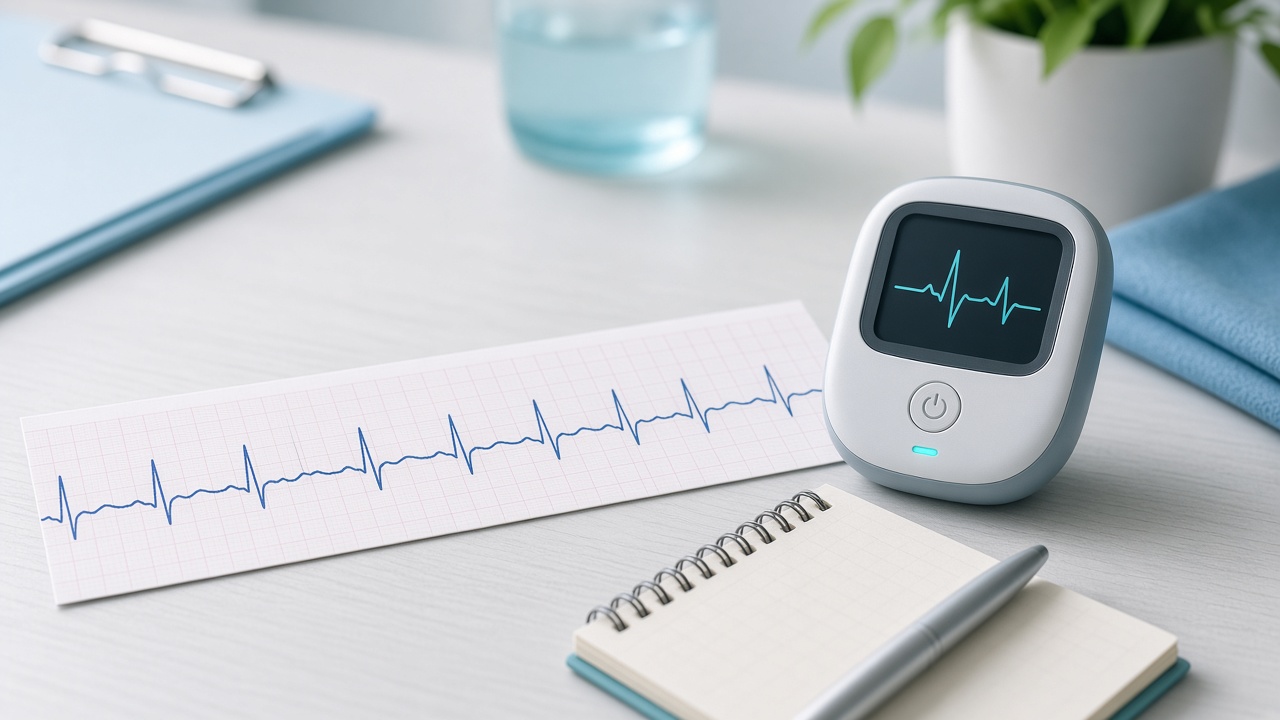
Chest fluttering with no pain can feel like a quiver, flip, vibration, or a few fast beats inside your chest. The absence of pain is useful information, but it does not identify the rhythm or prove that the sensation is harmless. A short episode with no other symptom may be appropriate for a scheduled visit. Fluttering with fainting, severe shortness of breath, chest pressure, or a racing heartbeat that will not settle needs urgent attention.
This guide explains what no pain does and does not tell you, what details help a cardiologist, and when to use emergency care. It is not a home rhythm test. If the sensation is new, keeps returning, or is difficult to explain, a clinician can decide whether you need an ECG, a monitor, or another evaluation.
What chest fluttering can feel like
People use the word flutter for several different sensations. You may feel a brief quiver, a flip-flop, a pause followed by a stronger beat, a buzzing feeling, or a rapid series of beats. Some people feel it high in the chest or throat. Others notice it near the breastbone, under a rib, or when lying down. The description is valuable, but it is not the same as an ECG recording.
A flutter may last a second, come in clusters, or continue long enough to make you stop what you are doing. It may appear while you are resting, after exertion, during stress, after poor sleep, or without an obvious trigger. Write down the sensation in your own words rather than trying to select a diagnosis from a search result. The timing and associated symptoms often matter more than the label.
Fluttering, racing, and a skipped beat
A skipped beat may actually be an early beat followed by a pause and a stronger beat. A racing sensation may be a fast rhythm, a normal heartbeat made more noticeable, or a response to stress, fever, dehydration, or another condition. A flutter can describe either a rhythm sensation or movement in the chest wall. These experiences overlap, which is why the same phrase can lead to different pages in search results.
The existing causes of fluttering in the chest guide covers the broader list of possibilities. This page focuses on the question many people ask next: what changes when there is no pain?
What no pain tells you, and what it does not
No pain means the episode does not include the discomfort people often describe as pressure, squeezing, burning, or soreness. That can make the symptom feel less alarming, but it does not tell you whether the beat is regular, irregular, early, or too fast. It also does not tell you whether the cause is cardiac, medication-related, metabolic, respiratory, digestive, or in the chest wall.
It is possible to have a rhythm problem without chest pain. It is also possible to notice a harmless extra beat without pain. Both statements can be true. The safest next step depends on the whole pattern, including how long the episode lasts, whether it starts with activity, whether it repeats, and whether you feel faint, breathless, weak, or confused.
Do not use “no pain” as permission to ignore a symptom that is getting more frequent or more intense. If the sensation is new and recurring, book a visit even if each episode ends on its own. If it happens with warning symptoms, use urgent care instead of waiting for a routine appointment.
Common reasons a painless flutter may happen
A flutter can have more than one possible explanation. Common triggers include stress, poor sleep, caffeine, alcohol, nicotine, fever, dehydration, and some medicines or supplements. A person may also notice normal heartbeats more strongly after exercise or when lying quietly. That does not mean you should assume a trigger is the diagnosis.
- Extra beats: An early beat can feel like a pause, thump, or flip. A clinician may use an ECG or monitor to see how often it occurs.
- Fast rhythms: Some rhythms begin and end suddenly. The timing, rate, and associated symptoms help determine what evaluation is appropriate.
- Stress and adrenaline: Worry, a stressful event, or a sudden rush of adrenaline can make the heartbeat feel prominent or fast.
- Body changes: Fever, dehydration, anemia, thyroid problems, and electrolyte changes can affect how the heart feels or beats.
- Medicines and stimulants: Decongestants, energy products, nicotine, some prescriptions, and supplements may matter. Bring the full list to the visit.
- Chest-wall sensations: Muscle twitches or movement around the ribs can feel like a flutter even when the heartbeat is not the source.
This list is a reason to gather better information, not a reason to self-diagnose. If a new supplement or medicine appeared before the symptom, tell the prescribing clinician. Do not stop a prescribed medicine without medical advice.
When a painless flutter is an emergency
Call 911 or seek emergency care if fluttering is accompanied by fainting, near-fainting, severe shortness of breath, new chest pressure, severe weakness, confusion, a blue or gray appearance, or a heartbeat that feels dangerously fast and does not settle. Also seek urgent help if the symptom begins during significant exertion and does not stop with rest.
Emergency symptoms can be brief or can occur after the flutter. Do not wait for pain to appear. Do not drive yourself if you feel faint, confused, severely short of breath, or otherwise unsafe. The chest emergency guide explains the difference between emergency warning signs and a symptom that can be discussed at a scheduled visit, but it cannot replace emergency assessment while symptoms are happening.
If the episode ended and you feel well now, the right choice still depends on what occurred. A new severe episode, repeated episodes with dizziness, or a pattern that is becoming more frequent deserves prompt medical advice. A mild, brief sensation with no warning symptoms may be appropriate for a scheduled evaluation, especially when you can describe the pattern clearly.
When to book a cardiology visit
Schedule a visit when the flutter keeps returning, lasts longer than a moment, interrupts sleep or activity, begins during exercise, or comes with breathlessness, unusual fatigue, dizziness, or a sense that you may faint. A cardiology visit is also reasonable when you have a history of heart disease, a known rhythm problem, high blood pressure, thyroid disease, anemia, or a family history of sudden cardiac problems.
You do not need to know whether the sensation is a premature beat, atrial fibrillation, supraventricular tachycardia, anxiety, or a muscle twitch before you call. The point of an evaluation is to sort that out safely. The chest flutters explainer can help you describe the sensation, but it is not a substitute for recording the rhythm.
What to record before the appointment
- the date and time the flutter began;
- what you were doing and whether you were resting or active;
- how long it lasted and whether it stopped suddenly;
- whether the beat felt fast, irregular, forceful, or like a pause;
- caffeine, alcohol, nicotine, illness, poor sleep, stress, or new supplements; and
- shortness of breath, dizziness, faintness, sweating, pressure, or weakness.
You do not need to keep checking your pulse until the next episode. If you happen to have a heart-rate reading from a device, save it with the time and circumstances, but do not let a consumer device decide whether an urgent symptom is safe.
What a cardiologist may check
The visit usually starts with questions about the sensation and a review of your health history. The clinician may ask about how the episode starts and ends, whether it follows exercise or a meal, and whether you have had fainting, breathing changes, chest pressure, swelling, or unusual fatigue. Bring your medicine and supplement list, including over-the-counter products.
An ECG may capture the rhythm during the visit. If the flutter is intermittent, a longer monitor may be more useful because it records while you go about your normal day. Depending on your history and examination, the clinician may consider blood work or imaging. Not every person needs every test. The aim is to match the evaluation to the symptom pattern rather than ordering a fixed checklist for everyone.
Be honest if the episodes are hard to describe or if anxiety made the sensation feel stronger. That does not make the symptom imaginary. It gives the clinician more context. Stress can influence the heartbeat, and a heart rhythm can also cause understandable worry. Both parts of the story belong in the appointment.
What about a flutter that feels like a butterfly?
Some people describe a flutter as butterflies, bubbles, or a dropping feeling. The butterfly feeling in the chest page addresses that wording. A butterfly sensation can come from a heartbeat, muscle movement, digestion, stress, or another cause. The phrase itself cannot confirm where it starts.
Note whether the sensation changes with movement, breathing, eating, posture, or exercise. Also note whether you can feel a pulse change at the same time. Those observations can help a clinician decide what to ask next, but they are not a home test. If warning symptoms appear, stop trying to categorize the feeling and seek urgent help.
How to decide what to do next
Use the symptom pattern, not the absence of pain alone. Emergency symptoms call for 911. A recurring or unexplained episode without warning symptoms calls for a scheduled medical or cardiology visit. A one-time sensation that has ended and has no concerning features can be written down and watched, but it should be discussed if it returns.
If you are unsure, calling a medical office for guidance is better than searching for a reassuring label. You can schedule an appointment with Prime Heart and Vascular for a recurring or unexplained flutter. If the episode is happening now with faintness, severe breathing trouble, chest pressure, or a heartbeat that will not settle, use emergency services instead.
A calm next step is still a real next step
Chest fluttering with no pain is often a symptom people postpone because it does not feel urgent. Sometimes it can wait for a scheduled visit. Sometimes the lack of pain is only one detail in a pattern that needs prompt evaluation. Write down what happened, notice the warning symptoms above, and ask for help when the episodes repeat or remain unexplained.
A cardiologist does not need you to arrive with the correct diagnosis. Bring the timing, the sensation, the associated symptoms, and your medication list. That is enough to start a more useful conversation.
Schedule an appointment with Prime Heart and Vascular to discuss recurring or unexplained chest fluttering. If emergency warning symptoms are happening now, call 911 instead.
Frequently asked questions about chest fluttering with no pain
No. No pain is one detail, not a diagnosis. A painless flutter may be an extra beat, a fast rhythm, a stress response, a medication effect, or a chest-wall sensation. It can also occur with a condition that needs evaluation. Seek emergency help for fainting, severe shortness of breath, chest pressure, confusion, or a heartbeat that will not settle. If it keeps returning or remains unexplained, schedule a medical or cardiology visit.
Call 911 when fluttering occurs with fainting, near-fainting, severe shortness of breath, new chest pressure, severe weakness, confusion, a blue or gray appearance, or a very fast heartbeat that does not settle. Do not wait for pain to appear. Do not drive yourself if you feel faint, confused, severely short of breath, or unsafe. Emergency symptoms belong in emergency care, not a routine cardiology appointment.
Possible contributors include extra beats, fast rhythms, stress, poor sleep, caffeine, alcohol, nicotine, fever, dehydration, anemia, thyroid changes, medicines, supplements, or muscle movement around the ribs. These possibilities overlap, and the sensation alone cannot identify the cause. Bring your medication and supplement list to a clinician and describe when the symptom begins, ends, and repeats.
A scheduled cardiology visit is reasonable when the flutter keeps returning, lasts longer than a moment, interrupts sleep or activity, begins during exercise, or comes with dizziness, breathlessness, unusual fatigue, or near-fainting. It is also reasonable with a heart history or a known condition that can affect rhythm. You do not need to identify the rhythm before booking. Emergency symptoms need 911 instead.
Record the date and time, what you were doing, how long the episode lasted, whether it stopped suddenly, and whether the beat felt fast, irregular, forceful, or like a pause. Note caffeine, alcohol, nicotine, illness, poor sleep, stress, new supplements, and any dizziness, breathlessness, sweating, pressure, or weakness. A device reading can add context, but it cannot determine safety.
An ECG may capture the rhythm during the visit. If episodes are intermittent, a longer monitor may record what happens during ordinary activities. Depending on the history and examination, a clinician may consider blood work or imaging. Not everyone needs every test. The evaluation should match the pattern rather than follow a fixed checklist.
Stress and adrenaline can make the heartbeat feel prominent or fast, and poor sleep can make that sensation easier to notice. That does not prove stress is the only cause. A recurring, new, or unexplained flutter still deserves an appropriate evaluation, especially if it comes with dizziness, breathlessness, faintness, or activity. Do not dismiss a symptom solely because you feel anxious.
If it was severe, new, unexplained, or accompanied by emergency symptoms, seek urgent medical advice even if it has stopped. If it was mild and ended without warning symptoms, write down the pattern and arrange an evaluation if it returns or remains unexplained. If it comes back with fainting, severe breathing trouble, chest pressure, or a heartbeat that will not settle, call 911.